Yes, I Look Away (Sometimes)
And you should, too…
While some may view that as privilege (I do, too, for what it’s worth), I hope you’ll stick with me long enough to hear why I still say this.

I’ve come to see this “looking away” as the discipline of looking toward something else, and I believe it’s allowed me to engage with the world, and our difficult current political situation, more effectively. Hear me out.
I open my phone in the morning, which is a bad enough habit already, but I’m hardly alone in this. My thumb swipes through my notifications, and whether I want to or not, within minutes, I’ve seen the headlines. My jaw tightens along with my chest. My shoulders feel heavy. My breaths are shallow. I feel my body doing what it does now—the thing it didn’t used to do quite so quickly, before I went through a lot of trauma healing, and before MG came crashing into my life. It’s the cortisol response that I feel far more acutely with a dysfunctional nervous system and a misfiring immune system. When the cortisol floods in, and my nervous system considers something might be a threat, it doesn’t take much convincing. The impact can be debilitating.
I care, deeply, about what’s happening in the world. I’m not interested in pretending otherwise, and I’m not writing this to talk myself out of caring. I’ve just had to get honest about something that took me a long time to both realize and admit: my body cannot sustain unlimited exposure to that caring in its rawest, most reactive form. Not without a heavy cost that comes in the form of flares, adrenaline dumps, tachycardia, migraines, physical pain, and extreme fatigue. Historically, I’ve been a master of dissociation in order to “push through” and keep functioning, no matter the objective stress level. That also comes with a high price I’m no longer willing to pay. So, I must learn how to stay sustainably present.
And that’s what I’m talking about here, when I say yes, I look away sometimes. I’ve had to learn the difference between looking away because something doesn’t concern me, or because it disturbs me, and looking away—sometimes, deliberately, temporarily—because staying locked into it at full intensity is not actually sustainable for the years of showing up I’m trying to build.
I want to hold two things at once here, because I think the conversation usually collapses them into one, and that collapse is where a lot of the guilt and judgment come from.
The first thing is true; it is a privilege to be able to look away from injustice that doesn’t touch us directly. People living the consequences of the political moment we’re in don’t always get to close the app and step outside for twenty minutes. Their body doesn’t get a choice about whether to be affected. Privilege is real, and I don’t want to write a single word here that erases it or lets anyone off the hook for using it as a permanent exit from responsibility. Some of us are directly impacted by facets of our political climate and still have to find ways to look away at times, when we can. As a queer, disabled woman, I’m not immune or exempt. But as a white-presenting person with financial security and family/community support, I’m more privileged than many, and I don’t discount that.
The second thing is also true (and doesn’t cancel the first one out); for some bodies, sustained high-alert engagement isn’t a healthy option. It has measurable cost, and for me, that cost is a debilitating autoimmune response. Stress isn’t an abstract experience here—it’s a direct trigger for physical flares that can put me in a hospital bed, the way it did in December. Managing my exposure to acute stress is disease management, and not as simple as saying it’s me being privileged or precious about my feelings. This awareness and management of stress is as important as any medication I take.
Neither of those truths erases the other. I think that’s the nuance missing from a lot of these conversations. It’s the assumption that, if you name the cost, you must be trying to excuse the privilege, when really I’m just trying to tell the truth about both at once. Yes, it’d be far simpler if it was black-or-white, one-or-the-other. But it’s not.
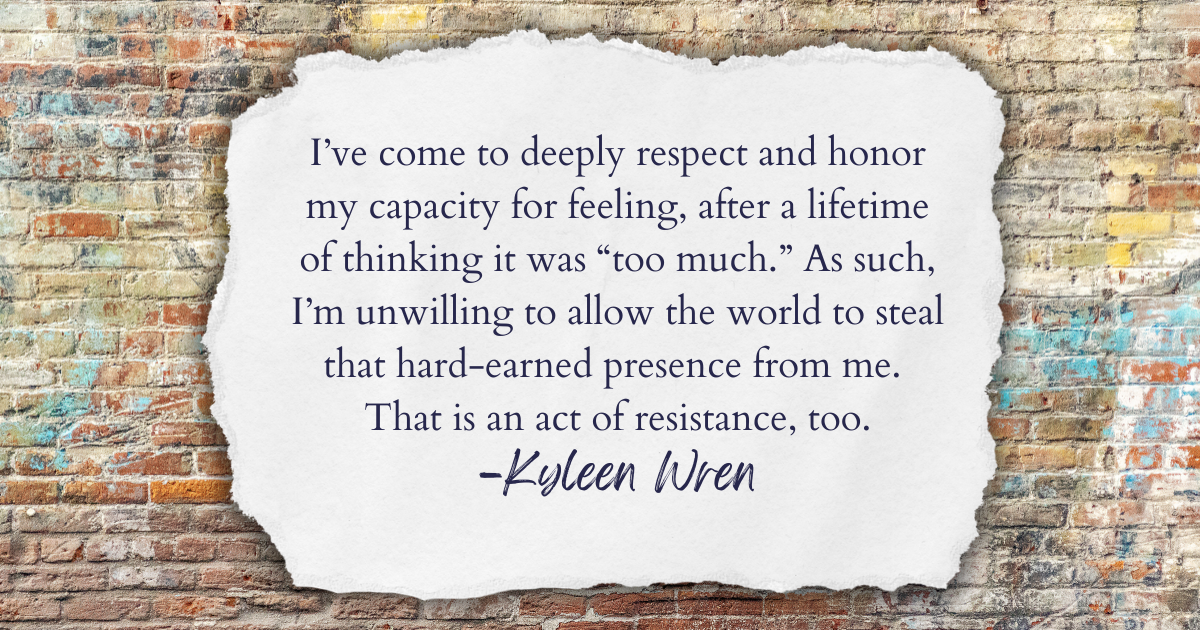
This is the reality for many of us who have deep empathy and have spent countless hours crying, breathing, writing, singing, creating, and crying some more over the state of our world. I’ve come to deeply respect and honor my capacity for feeling, after a lifetime of thinking it was “too much.” As such, I’m unwilling to allow the world to steal that hard-earned presence from me. That is an act of resistance, too.
This is the reframe that’s taken me the longest time to actually believe.
If I push through until I flare, it isn’t some beautiful, moral choice; it only looks like one from the outside, because our culture tends to treat burnout as proof of commitment. But a body in medical crisis isn’t serving anyone. It doesn’t serve the causes I care about. It certainly doesn’t serve my kids, who need and deserve a functional and present parent, instead of one barely there during long recoveries. It doesn’t help me, either, obviously, but also harms the version of me that wants to still be invested and active in the world ten years from now, or twenty.
Sustainability isn’t the opposite of caring deeply. For me, it’s evidence of it. It’s what makes it possible for me to care deeply for the long haul instead of the brief, blazing months before inevitable collapse. I’d rather be useful for decades in whatever form my body allows than maximally intense for a season, only to end up absent and recovering for the year after. Or longer.
I want to be careful here, because this is exactly the point where this might quietly turn into permission to disengage completely, and that’s not what I mean. There’s a difference between numbing and pacing, and I’ve learned where that sits in my body, from years of trial and error.
Numbing is when we decide something doesn’t concern us, or that we just can’t handle it, so we close the door on it. Pacing is staying in the room, but managing the dose of this ongoing, real, unresolved trauma so that we can still be standing that room next year. Numbing looks away and stays away. Pacing steps back, catches its breath, looks toward integration and equilibrium, then comes back in a form it can actually sustain. I chose the latter.
For me, in practice, that’s looked like choosing which fights I follow closely and in real time, and which ones I support from slight remove. Maybe that’s donating when I can, or boosting other peoples’ work and words instead of needing to generate my own take on every single thing. It’s been local conversations and community that don’t require me to be plugged into the national news cycle at full volume every hour of every day (as a neurodivergent person, this is very easy for me to fall into). It’s been getting honest with myself about how much doomscrolling I let myself do, and moderating it some. I’m listening to more music. I’m writing when I can, instead of only consuming. That’s actually a big key: making something, even something small, uses that same energy in a way that doesn’t just corrode me from the inside.
None of this means I’ve stopped caring, or stopped acting. It means I’ve stopped pretending my nervous system has infinite bandwidth, because pretending otherwise landed me in a hospital bed in the past, and it will again if I let it.
But here’s the thing. I don’t think you have to have a life-altering diagnosis to benefit from this approach. The truth is, all people have a limit to what their bodies can handle, disabled or not. Stress is a silent killer, and we all know this on some level. I just happen to have that physical manifestation sooner and louder than others might. So, I actually do encourage people to look away sometimes, temporarily. This is because the more we do this, the more we learn where our limits really are.
Over time, as we exercise that muscle, and prove to ourselves that we’re paying attention to our bodies and willing to make adjustments for ourselves, the greater trust our bodies will have in us to handle more. That’s one of the cool things about how most of us work. We can increase our window of tolerance with practice, but only when we honor the messages from our bodies. When we prove through consistent action that we can handle the responsibility, we’re offered more.
I won’t pretend I’ve resolved this in my own heart, or that I don’t feel guilt. Some days, I still do. I have worries that stepping back, even briefly, even strategically, makes me complicit somehow. This is easy to believe, not only due to our own integrity and desire to do and be more, but is further reinforced when we see the discourse online, especially in spaces that fall toward any kind of activism. I watch people push themselves harder, speak louder, and stay online longer. Some small part of me wanders if I’m failing because I can’t do the same, but then I remember that this is not a unique feeling to me, nor to politics alone. I feel the same inadequacy and guilt throughout my day, when I see what other parents can do with their kids, or notice folks much older than I am, out and active in ways I haven’t been able to be in ages.
But then I remember that the version of me who ignored her body’s limits in the name of always being maximally engaged is the same version of me who ended up too sick to be engaged in anything at all.
I’d rather build something that lasts, because I plan to be around for a while.
So, if you’re managing chronic illness, or really any kind of limited capacity (for literally whatever reason) alongside caring about what’s happening in the world, I don’t think you owe anyone an explanation for pacing yourself. I understand the urge, believe me. But sustainable, “small” moments of participation don’t render our contributions meaningless. Showing up in whatever way our bodies allow, for the next twenty years, is worth more than burning ourselves down for a few months of intensity.
We’re allowed to care and to protect our nervous systems. We’re allowed to look away sometimes, with intention, toward restorative things, so that we can keep looking at the hard ones in the long run.
May we continue to create and hold balance for ourselves as we participate in making this world a better place.